How Serial Fiction Reached Readers Through Periodicals
Serial fiction reached readers through newspapers and magazines, where recurring installments made long stories part of a familiar reading routine.
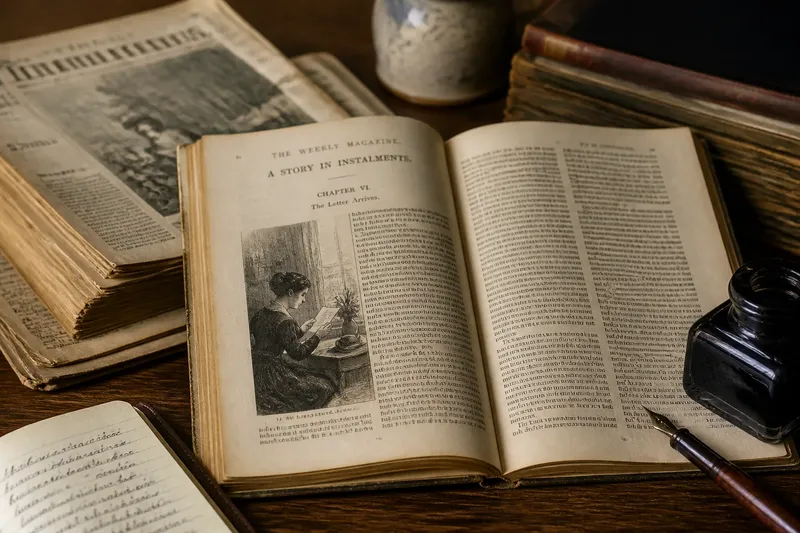
Serial fiction reached readers through newspapers, magazines, and other periodicals that people already read for news and essays. Rather than arriving only as a complete book, a story could appear in successive parts, giving its audience a recurring place to meet the narrative. This was one way long fiction circulated, not a stage that every novel had to pass through.
That route shaped more than the size of each reading session. Publishers placed fiction within publications with established readers; writers built continuity across intervals; and readers returned to find out what had changed. To understand the form, it helps to notice both how stories reached an audience and what the pause between parts did to the experience.
How did periodicals bring serial fiction to readers?
A periodical could carry a continuing story alongside material its readers already expected to find. A newspaper or magazine therefore served as a route to an audience: readers might encounter a new installment while reading the rest of an issue, rather than seeking out a separate volume. The publication’s existing habits of circulation and reading made the next part available in a familiar setting.
Publishers could use fiction as one of the features that invited readers to return to a publication. The precise arrangement varied: installments might appear at recurring intervals, but there was no single schedule or format common to every serial. Some narratives were later collected into books; others were composed with the continuing publication in mind.
This history is not a simple “before and after” story. Serial fiction existed in different traditions and alongside book-length fiction. Its significance lies in the particular relationship among publication, audience, and narrative timing, not in a claim that serials came first and novels followed in a uniform sequence.
Why publish a story in installments?
Breaking a long narrative into parts let a periodical present it across issues and gave readers a recurring occasion to follow it. Each installment could offer a manageable portion while keeping the larger story in motion. The format also created intervals in which readers could remember details, talk about developments, or anticipate what might happen next.
Writers had to attend to two scales at once: each part needed to offer a satisfying reading experience, and the whole needed to remain coherent across pauses. A section might resolve a local problem while leaving a larger question open. A short reminder of characters or past events could help readers return, though too much recap could slow the current scene.
What does the pause between parts change?
When readers cannot move directly to the next scene, an unresolved question may stay in mind. That pause can make a decision, a character, or a detail feel more prominent than it might during uninterrupted reading. Suspense is one possible effect, but serial writing can also use a change in setting, a quieter ending, or a temporary resolution.
Imagine a fictional family story appearing in a weekly magazine. One installment ends when a letter arrives, but the writer’s name is not yet revealed. During the gap, readers can wonder who sent it; in the next part, the answer might resolve that question while introducing a new family concern. The result is anticipation built from both an answer and a fresh thread, not from a cliffhanger alone.
How does serial fiction differ from a story collection?
A collection gathers separate stories, which may share a theme or setting without asking readers to follow one continuing plot. A serial asks readers to carry characters, questions, and events from one installment into the next. Even when serial parts are later bound together, that continuing narrative distinguishes the form from a collection of independent stories.
What questions help readers understand serial fiction?
Did every serial installment end with a cliffhanger?
No. An installment could close on suspense, but it might also offer a temporary resolution, shift the setting, or end quietly. Continuation between parts—not a startling final moment—is what makes the story serial.
Why do serial stories repeat details?
A brief reminder can help a reader recall who is involved and which problems remain open after an interval. Too much repetition, however, can interrupt a scene, especially for someone reading several parts together.
Why read a serial in its original parts?
Separate installments make the publication rhythm easier to notice: what a part resolves, where it pauses, and what remains in memory. A collected edition still reveals the story’s design, but reading straight through softens the intervals.
Is serial fiction simply an early form of the novel?
No. Serial publication and book-length fiction have varied histories and could exist alongside one another. Treating serial fiction only as a precursor to the novel obscures its distinct ways of reaching readers and shaping attention.
What should readers notice in a serial today?
As you read, ask what each installment makes clear and what it leaves unresolved. Notice whether it offers a small conclusion, introduces a new concern, or returns to a detail whose meaning has shifted. These observations reveal how the narrative manages continuity without reducing every ending to a trick.
It is not worth searching for a cliffhanger in every section. Some installments may draw their force from character, setting, or social observation, and the pause may simply be part of publication’s rhythm. Looking for only suspense can hide the other ways a story keeps readers engaged.
For instance, say you have a collected edition of a fictional mystery originally published in parts. You read one installment, note that it identifies a missing key but does not explain why it matters, and stop before the next section. The open question gives you a sense of what the original interval might have held; when you continue, the key’s role becomes clear, though a character’s motive remains uncertain. Reading in this way does not recreate every historical reader’s experience, but it makes the serial’s pattern of partial answers and continuing questions easier to see.
Serial fiction reached readers by joining a continuing story to the periodicals they already encountered. When reading it now, the main search phrase, serial fiction, points to both sides of the form: how publication brought the story to an audience and how each pause shaped what that audience could notice.