Watching Your First Dance Performance from the Stage Edges
At your first dance performance, follow entrances, the front boundary, or stage corners to see how dancers shape space and direct your attention.
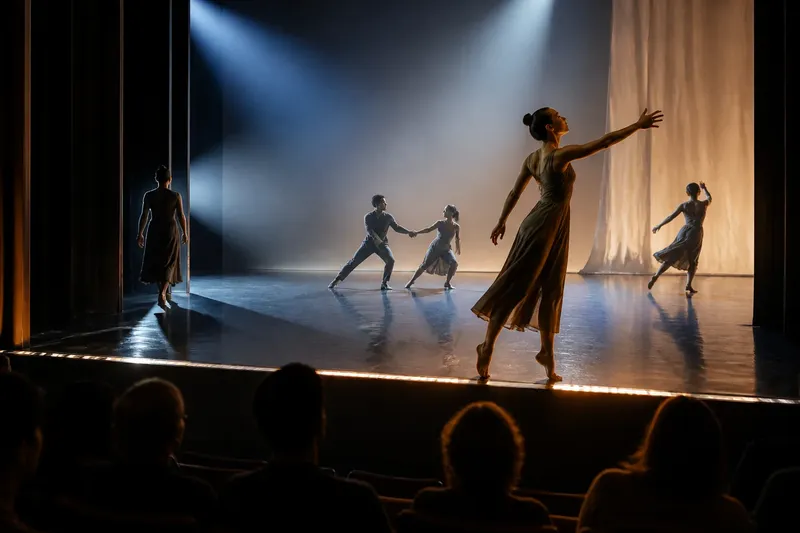
At your first dance performance as an audience member, the stage edges can show how choreography directs attention. Watch where dancers enter, pause, turn away, or approach the front, and you will see how a boundary becomes part of the movement rather than just a frame around it.
This viewing approach helps if the steps and styles feel unfamiliar. You do not need to identify every movement. Choose one way to watch the edges, follow it for a while, and notice how the dancers’ changing relationship to the boundary guides your attention.
What can a stage edge tell you?
A stage has practical limits: the wings conceal what is waiting, the front separates performers from the audience, and the corners restrict the space available for movement. Choreographers can make those limits visible or appear to brush past them. A dancer who stops just short of the front edge creates a different impression from one who travels toward it.
Notice the distinction between stage space and offstage space. The wings are areas beside or behind the visible playing space; an entrance from them can make a dancer seem newly revealed, while an exit can leave a movement or relationship unresolved. A boundary might be marked by a curtain, a strip of light, the edge of a raised platform, or the point where the audience area begins.
Stay with what you can see rather than guessing at a hidden story. A dancer’s retreat may suggest hesitation, but it can also be a practical transition into the next formation. Ask what the movement does to your attention: does it draw your gaze outward, redirect it toward another dancer, or make the stage feel smaller?
Which way of watching the edges suits you?
Three approaches offer different threads to follow. Choose one rather than trying to track every entrance, formation, and gesture at once.
Follow entrances and exits
Watch where dancers appear and disappear, and notice whether they use the same route or vary it. This approach suits performances with a clear cast of characters or shifting groups, because the stage edge can help you keep track of who is present and how the focus changes.
Follow the front edge
Notice when performers face the audience, approach the front, or turn their backs and travel away. This suits a work that feels directly addressed to the audience, as well as one that makes distance or concealment part of its mood. You can notice the relationship without treating a gesture as a fixed symbol.
Follow the corners and sides
Look for movement that gathers in a corner, crosses from one side to another, or leaves an area conspicuously open. This approach suits choreography with several dancers or changing group shapes, where the edges can reveal how attention moves around the stage. It is also useful if you prefer to watch patterns rather than follow one performer.
Say you are watching a trio and one dancer repeatedly leaves by the same wing while the other two remain near the front. Following entrances and exits lets you notice the repeated route; following the front edge lets you see how the remaining pair’s distance from the audience changes. Both are valid observations, but each gives you a distinct line of attention.
How can you adapt your attention during the performance?
Before the dance begins, locate the visible boundary and note whether the stage has wings, a curtain, or an unraised floor that meets the audience area. During the opening, choose one approach and watch for a recurring use of the edge. Later, switch if the choreography changes direction or the first thread no longer holds your interest.
Imagine a group beginning in a tight cluster near a side wall, then spreading toward the front. You notice that the dancers claim more of the stage and seem closer to you, even without naming the steps. If a performer exits, glance at the space left behind before following those who remain.
Your seat can affect the view. From the side, a dancer’s approach to the front may look diagonal, while from the center it may appear direct. If you cannot see a wing clearly, concentrate on the visible edge and on the moment a dancer crosses into or out of view. You do not need to turn your head throughout the performance to compensate.
What should you notice at the stage boundaries?
- Nearness: If a dancer stops short of the boundary, notice the gap; if the dancer approaches it, watch whether the movement appears contained or presses outward, then follow the next visible action.
- Direction: If movement travels toward an edge, track its arrival; if it runs parallel to the edge or turns away, notice the change and follow the new direction.
- Timing: If an entrance arrives with the music, notice the alignment; if it comes after a pause or while attention is elsewhere, watch how the entrance redirects your gaze.
- Grouping: If dancers gather on one side, watch that cluster; if they divide between sides or leave an area empty, follow the resulting space and its effect on the formation.
- Focus: If someone leaves the visible space, notice where your eye goes next; if it stays on the empty area, attend to the pause, and if it moves to another dancer, follow that performer.
- Light and sound: If a pool of light creates an inner boundary, watch how dancers move into or out of it; if sound or lighting does not mark a clear edge, return your attention to the physical stage boundary.
These are observations, not clues with one correct translation. A repeated exit can make a pattern feel deliberate, while a single approach to the front can interrupt it. Lighting and sound may also change what counts as an edge: a pool of light can create a boundary inside the physical stage.
What do audience members ask about watching stage edges?
Should I watch one dancer or the whole stage?
Start with one dancer if entrances and exits are your chosen thread; look across the full stage if you are tracking sides and corners. Shift your gaze when a new movement draws attention, then return to your chosen approach.
Do dancers use the wings as part of the choreography?
Sometimes the wings function as a deliberate threshold, and sometimes they are simply where performers enter or leave. Notice whether timing, repetition, or spacing gives the crossing a clear role in the visible dance.
What if I cannot see the stage corners?
Use the edges you can see, especially the front boundary or a visible side. Entrances, exits, and changes in spacing remain readable even when a corner is hidden from your seat.
Do I need to know the dance style first?
No; this approach begins with visible choices such as direction, distance, and grouping. A program note can provide context, but you do not need one to notice how dancers use the space.
How do you choose an approach?
Choose the thread that matches what is easiest for you to track. If you like following people and changes in presence, watch entrances and exits. If you notice relationships between performers and audience, follow the front edge. If formations catch your eye, watch the corners and sides.
It is not worth trying to record every crossing or assign a meaning to each pause. A few clear observations can make your first dance performance as an audience member feel more legible without turning the evening into an exercise. The search phrase first dance performance can be ambiguous, so here it means your first time watching a dance performance, not a dancer’s career debut.
After the performance, recall one moment when a dancer’s closeness to an edge changed the shape of the scene. That specific image gives you a useful starting point for conversation, even if you are still deciding what the dance meant to you.